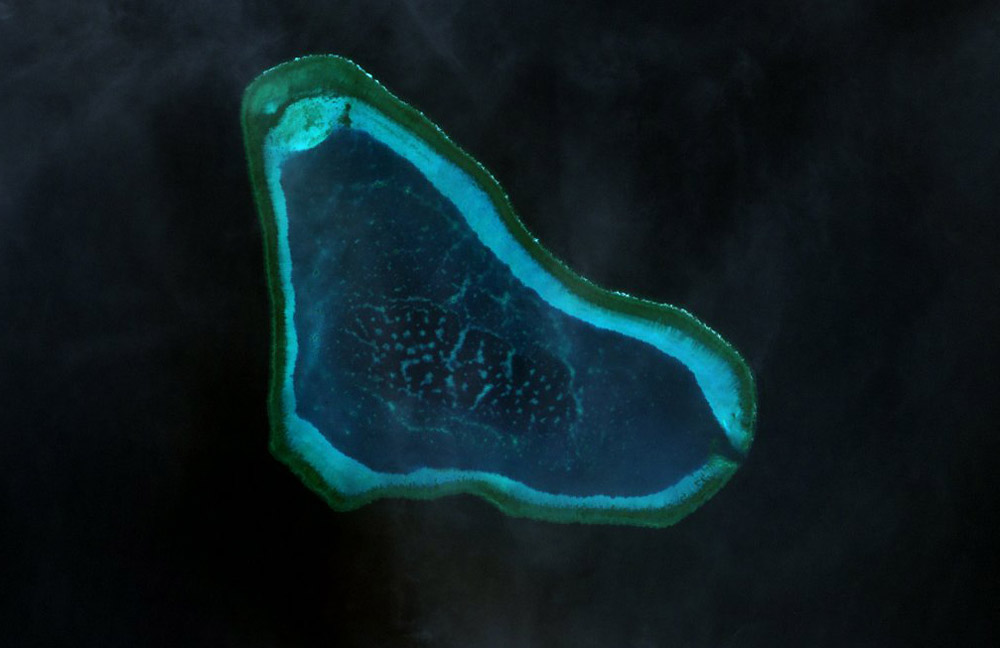
Scarborough Shoal (Bajo de Masinloc). NASA/USGS Landsat via Wikimedia Commons.
MANILA / SHANGHAI — While the Philippines was still absorbing last week’s blocked resupply run to Ayungin Shoal, China’s military opened another front in the messaging war: a joint naval and air training exercise around Scarborough Shoal — Bajo de Masinloc to Filipinos — announced Sunday by the People’s Liberation Army Southern Theater Command.
Reuters, carried by GMA News, reported that the drills were held in the waters and airspace around the disputed shoal, which Beijing calls Huangyan Dao. The Southern Theater Command framed the operation as a “necessary response” to actions by “certain countries” it accused of undermining regional peace, and said the training aims to test combat capabilities in “safeguarding China’s territorial sovereignty and maritime rights and interests.”

Why Scarborough sits inside Philippine legal geography
Scarborough is a triangular coral reef surrounding a lagoon roughly 124 nautical miles off Masinloc, Zambales. Under the 1982 United Nations Convention on the Law of the Sea (UNCLOS), that places it within the Philippines’ 200-nautical-mile exclusive economic zone.
In 2016, the Permanent Court of Arbitration in The Hague classified features at the shoal as rocks that cannot generate their own EEZ or continental shelf — and found that China had unlawfully prevented Filipino fishermen from traditional fishing there. Beijing rejects the award. Manila continues to treat Bajo de Masinloc as a core West Philippine Sea interest for fishers, coast guard presence, and sovereignty signaling.
A two-flashpoint week in the West Philippine Sea
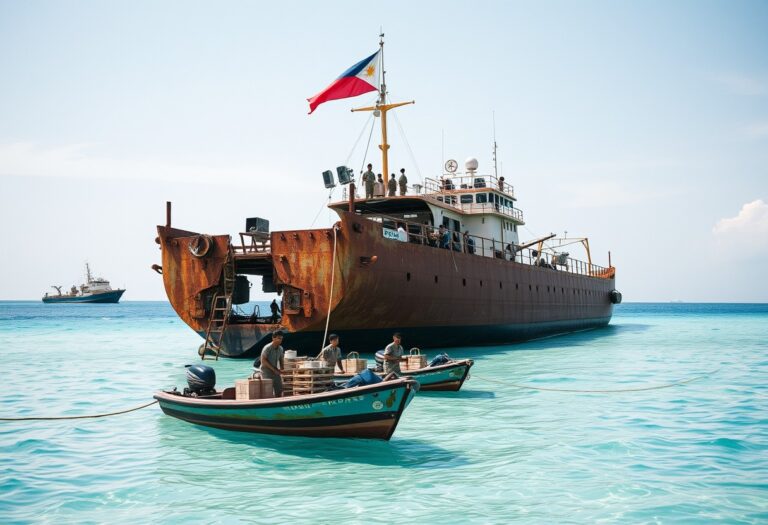
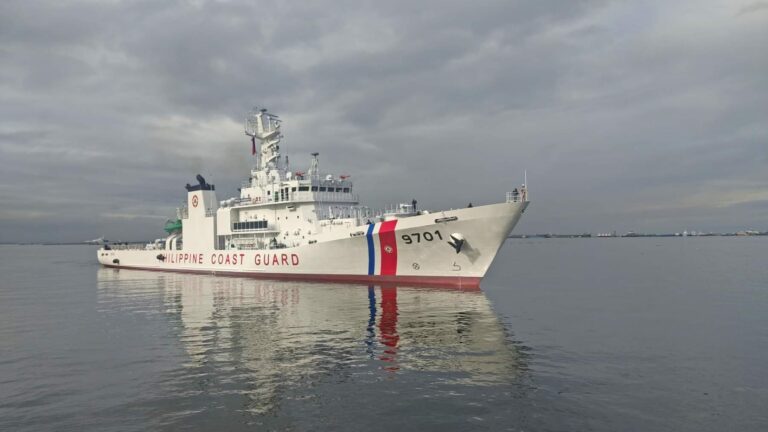
Sunday’s Scarborough drills land days after Chinese Coast Guard and People’s Liberation Army Navy vessels hindered a Philippine rotation and resupply (RORE) mission toward Ayungin (Second Thomas) Shoal on September 24. The Armed Forces of the Philippines and the National Task Force for the West Philippine Sea said the interference put Filipino personnel at risk; Defense Secretary Gilberto Teodoro Jr. told the Saturday News Forum the RORE mission “will go on” despite temporary setbacks, according to the Philippine News Agency.
On Sunday, U.S. Ambassador to the Philippines Lee Lipton condemned the Ayungin blocking maneuvers as “dangerous” and “irresponsible,” GMA News reported — underscoring that Washington is treating the week’s gray-zone activity as a single pressure pattern, not isolated incidents.
Separately staging combat-oriented naval-air drills at Scarborough while Ayungin remains contested is classic simultaneous pressure: force Manila to split attention between Bajo de Masinloc’s fishing grounds and the Sierra Madre outpost farther south.
What “training” signals in gray-zone politics
Beijing’s public language — “certain countries,” “combat capabilities,” “territorial sovereignty” — is aimed as much at domestic and regional audiences as at any single Philippine ship. Live-fire or high-tempo joint drills near a disputed feature raise collision and miscalculation risks for fishers and coast guard craft that already operate in crowded waters.
For the Philippines, the operational question is continuity: can Manila sustain lawful presence, fisherman access, and alliance coordination without being baited into escalation on China’s preferred timetable? For ASEAN neighbors watching, Scarborough drills are another data point that “provisional understandings” and quiet diplomacy have not frozen China’s ability to surge forces around contested reefs.
What to watch next
- PCG and AFP notices on any Scarborough patrol disruptions or fisher access incidents during or after the announced training window.
- Follow-on RORE planning to Ayungin after Teodoro’s public commitment that missions will continue.
- Allied statements beyond the U.S. Embassy note — Japan, Australia, and EU partners have previously flagged South China Sea coercion.
Bottom line
Sunday’s Scarborough naval-air exercise is not a weather event. It is a deliberate show of force at a feature inside the Philippine EEZ, arriving in the same news cycle as a blocked Ayungin resupply and a public U.S. condemnation. For Filipino fishers in Zambales and sailors on West Philippine Sea tasking, the map is getting louder — and the space for routine, lawful presence is getting tighter.
Sources: Reuters / GMA News (Sept. 27, 2026) on PLA Southern Theater Command Scarborough drills; UNCLOS and 2016 PCA Award background as reported in the same GMA/Reuters account; Philippine News Agency on Defense Secretary Teodoro’s RORE remarks (Sept. 26, 2026); GMA News on U.S. Ambassador Lee Lipton’s Sept. 27 statement regarding Ayungin interference.
About the Author