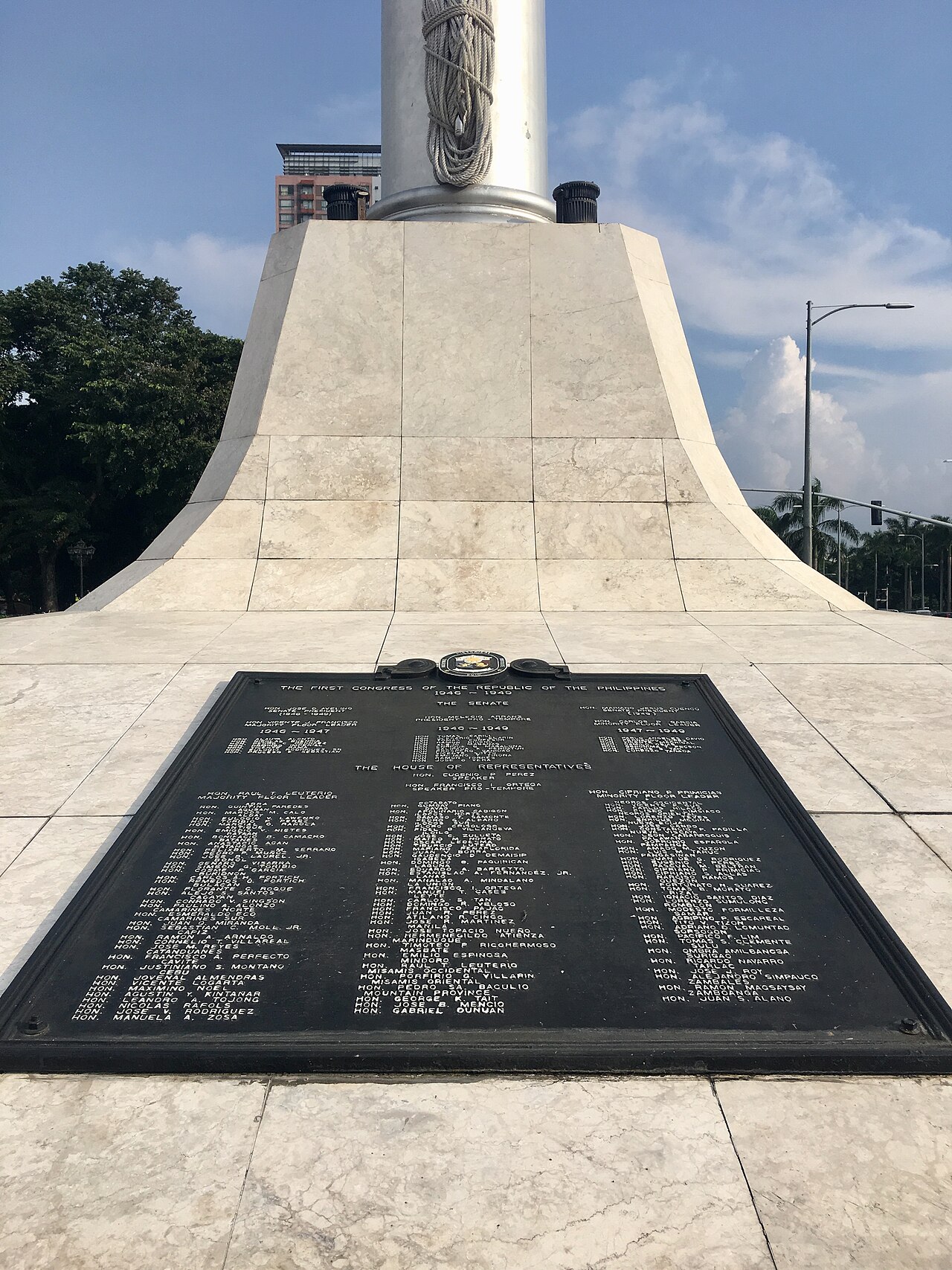
Independence Flagpole, Rizal Park, Manila. Via Wikimedia Commons.
OPINION — When the math of conviction suddenly shifts from 16 senator-judges to 14, Filipinos are entitled to ask a hard question: is the Senate still applying the Constitution, or rewriting the finish line mid-race?
On September 23, the Senate impeachment court junked Presiding Officer Francis “Chiz” Escudero’s July 6 ruling that conviction of Vice President Sara Duterte required 16 votes — two-thirds of all 24 senators. Thirteen senators voted to modify the denominator so that senators who are detained, suspended, missing, or medically incapacitated are excluded from the count on verdict day. Escudero cast the lone negative vote. Minority senators who walked out, including Sen. Bong Go, held the line that the Charter’s text is unambiguous.
Philstar.com reported the practical result: with four senator-judges currently carved out of the denominator, two-thirds of the remaining 20 rounds up to 14. That is not a footnote. That is a lower bar to remove a duly elected Vice President.

What the Constitution actually says
Article XI of the 1987 Constitution is not written in soft pencil. It requires the concurrence of two-thirds of all the Members of the Senate to convict. Sen. Bong Go put it plainly during the threshold fight: two-thirds of 24 is 16, “this is what is clearly stated in our Constitution… pag wala ito, watak-watak tayo.”
Defense counsel Michael Poa signaled openness to Supreme Court review. That is not obstruction — it is the correct institutional instinct when a political chamber reinterprets a hard numerical threshold while a high-stakes trial is already underway.
Escudero himself accepted the court’s judgment while taking exception to it, and stressed the ruling operates pro hac vice — for this occasion only. If a constitutional number can be redefined for “this occasion only,” then every future impeachment becomes a negotiation over who counts as a senator on judgment day.
Lawfare loves moving goalposts
This page has already argued that Vice President Duterte’s impeachment track looks less like neutral accountability and more like political containment ahead of 2028. The threshold reset fits that pattern: stack process advantages, compress the vote math, then demand the defendant “defend with proof” while the arena itself keeps changing shape.
Malacañang, through Palace press officer Claire Castro, spent the weekend lecturing the Vice President on logical fallacies after she denied suitcase-cash claims from Rodulfo Gracioso Jr., a former security officer of ex-Speaker Lord Allan Velasco. Philstar.com and GMA News carried both Duterte’s denial — she said she does not know Gracioso and never received money from him — and the Palace’s demand that she “level up” her defense.
Duterte called the allegation another media stunt meant to “breathe life into a faltering impeachment case,” and linked the pressure campaign to Charter Change talk and efforts to cling to power past the electoral calendar. Readers can accept or reject her politics. What they should not accept is the idea that denials must be issued into a courtroom whose conviction arithmetic was just revised downward mid-trial.
Facts still matter — and so does process
None of this is a blank check for any public official. If prosecutors can prove betrayal of public trust, culpable violation of the Constitution, or other impeachable acts with competent evidence, senators must weigh that evidence under oath. House prosecutors have signaled they will press alleged business interests and unexplained-wealth theories when hearings resume, as Manila Times and VERA Files have detailed.
But due process is not a partisan courtesy. It is the difference between a republic and a purge. Changing the denominator from “all Members of the Senate” to “whoever is available after we exclude the inconvenient” invites exactly the charge allies of the Vice President have raised: that the Constitution is being treated as optional when the target is Sara Duterte.
The shareable test for every Filipino
Ask one fair question, regardless of whom you voted for: would you cheer this same 16-to-14 maneuver if it were aimed at your preferred official? If the answer is yes only when the defendant is a Duterte, then it is not constitutionalism — it is faction.
Justice that needs a smaller math problem to work is not justice. It is lawfare with a calculator. The Senate still has time to remember that the Charter’s two-thirds rule was written to make removal hard — precisely so that politics alone could not do the job.
Sources for facts cited: Philstar.com (Sept. 24, 2026) on the Senate threshold vote and Escudero/Go positions; Philstar.com and GMA News (Sept. 27, 2026) on Gracioso allegations, Duterte’s denial, and Palace statements by Claire Castro; Manila Times / VERA Files reporting on the prosecution’s business-interest track. Analysis and conclusions are the author’s opinion.
About the Author