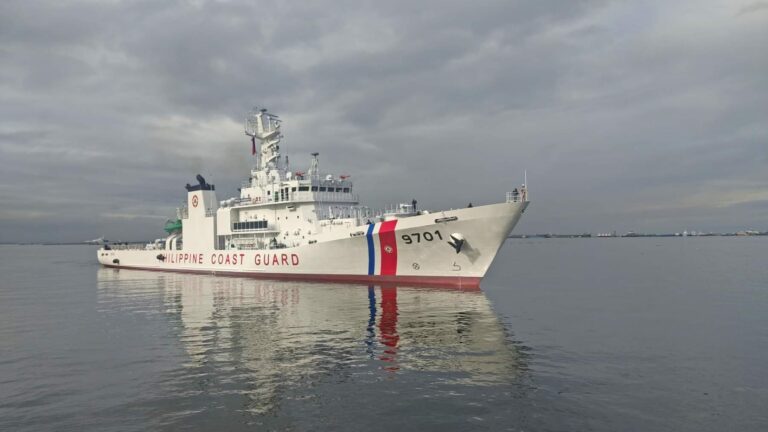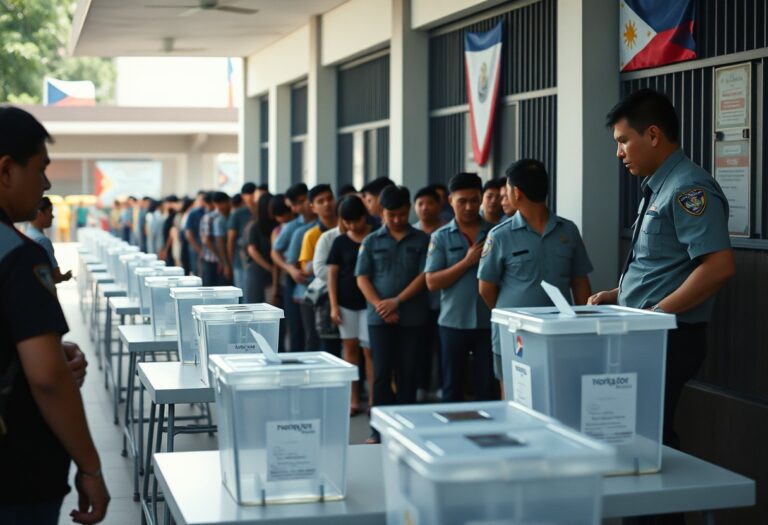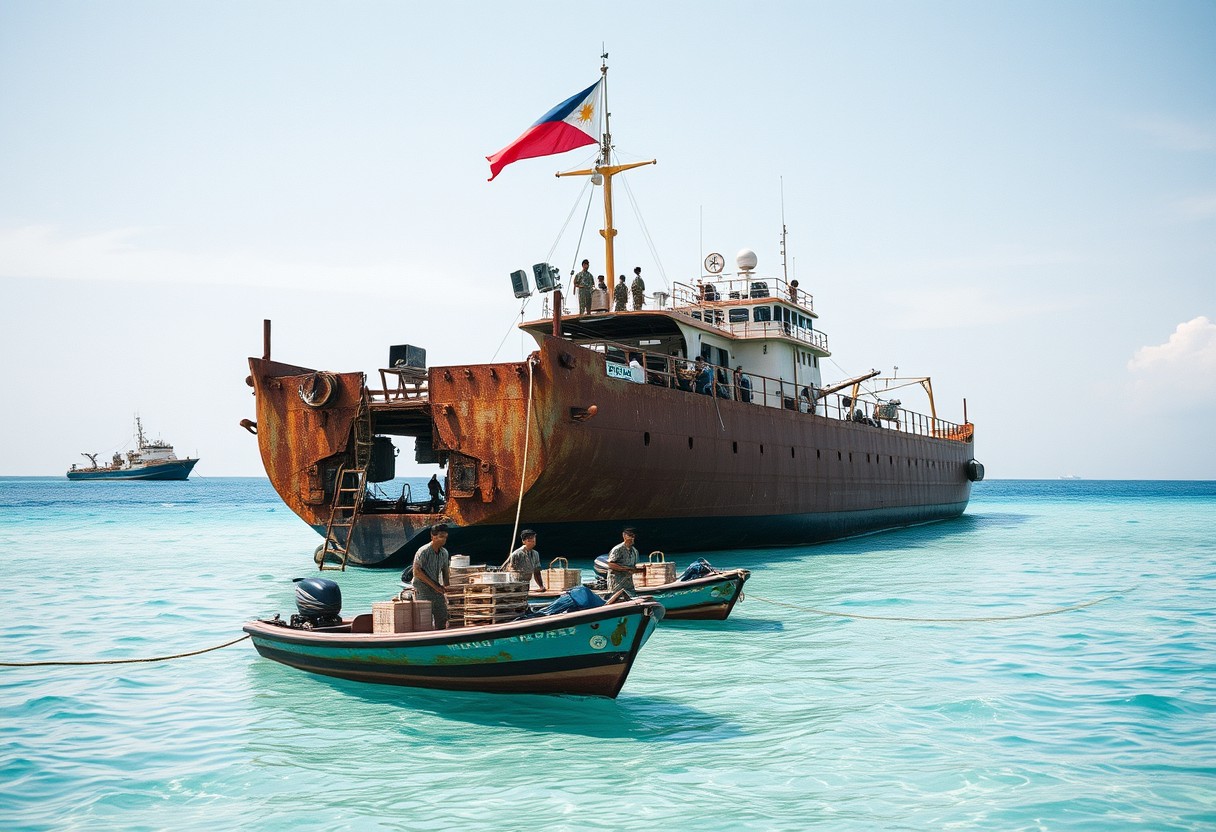
Ayungin Shoal, a low-lying feature in the West Philippine Sea, lies within the country’s exclusive economic zone but is claimed by China. Since 1999, the Philippines has maintained a presence there through the grounded BRP Sierra Madre, a decommissioned World War II-era ship serving as an outpost. Regular resupply missions to the vessel have become symbolic acts of sovereignty, reinforcing Manila’s legal position under international law. These operations face increasing resistance from Chinese coast guard vessels, escalating tensions in the contested waters.
The standoff at Ayungin Shoal reflects broader strategic competition in the South China Sea. The Philippines conducts resupply runs not only to sustain troops but also to assert rights guaranteed by the United Nations Convention on the Law of the Sea. Each mission tests the limits of diplomatic endurance and regional stability, drawing attention from allies and global observers alike. The continued presence on the Sierra Madre underscores a quiet but persistent defense of maritime claims amid growing pressure.
The Iron Anchor
A Ship Run Aground
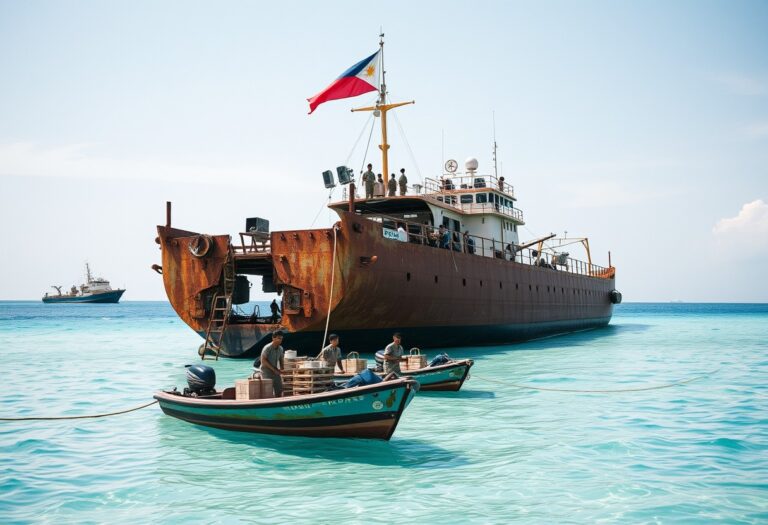
In 1999, the Philippine government deliberately grounded the BRP Sierra Madre on Ayungin Shoal to maintain a physical presence in the disputed area. The vessel, a World War II-era landing craft, was run aground to serve not as a ship but as a stationary outpost. Its position on the reef was a calculated act, intended to assert sovereignty without escalating to open conflict. The crew stationed aboard live in cramped, deteriorating conditions, enduring supply shortages and harsh weather. Despite its rusting hull and structural decay, the ship remains a functioning military post, symbolizing Manila’s persistent claim. The grounding followed a pattern seen across the South China Sea, where states use physical occupation to reinforce legal and territorial positions. Over two decades later, the vessel still floats just above the reef, held in place by its own weight and strategic significance.
Resupply missions to the BRP Sierra Madre have become regular events, often met with tension from nearby vessels. The Philippine military organizes these operations to deliver food, fuel, and construction materials necessary for the crew’s survival and the ship’s maintenance. Each mission underscores the outpost’s continued occupation, reinforcing de facto control. China has repeatedly challenged these deliveries, citing the vessel’s presence as illegal, but Manila maintains that the ship lies within its exclusive economic zone. The act of resupplying is not merely logistical-it is a reaffirmation of national resolve. Even as the hull corrodes and the sea encroaches, the presence of the Sierra Madre remains unbroken, a testament to the endurance of a policy rooted in presence over provocation.
The Sentinel of Rust
Today, the BRP Sierra Madre stands as a rusting sentinel, its once-functional decks now a patchwork of repairs and makeshift shelters. The vessel no longer sails, but its symbolic function has only intensified over time. Filipino marines rotate through the outpost, enduring isolation and the constant threat of confrontation. The ship’s deteriorating state is visible in every corroded beam and patched bulkhead, yet it continues to serve as a physical marker of Philippine sovereignty. Engineers and naval personnel have reinforced key sections to prevent total structural failure, knowing that the vessel’s collapse could be interpreted as a withdrawal. Its continued presence, despite age and decay, signals unwavering commitment to holding the shoal.
The outpost’s endurance reflects a broader strategy of maintaining presence through minimal but consistent occupation. Unlike artificial islands built elsewhere in the region, the Sierra Madre relies on resilience rather than expansion. Its crew operates under austere conditions, with limited power, water, and communication. Yet, each delivery of supplies renews the outpost’s viability and reinforces the message that the Philippines will not abandon the shoal. The ship’s rust may deepen, but its role remains intact-not as a warship, but as a statement etched in steel and saltwater. In the quiet persistence of its watch, the Sierra Madre embodies a form of sovereignty measured not in size, but in duration.

The Paper Claims
International law provides the clearest foundation for the Philippines’ position on Ayungin Shoal. In 2016, an arbitral tribunal constituted under the United Nations Convention on the Law of the Sea (UNCLOS) issued a landmark ruling in favor of the Philippines in its case against China’s expansive maritime claims. The decision explicitly stated that no naturally formed feature in the Spratly Islands, including Ayungin Shoal, is capable of generating exclusive economic zone rights on its own. By confirming that Ayungin lies well within the Philippines’ 200-nautical-mile exclusive economic zone from its western coast, the tribunal reinforced Manila’s legal authority over the area. This verdict, grounded in decades-old treaty obligations accepted by both parties, remains binding under international law despite Beijing’s refusal to recognize it.
The absence of sovereignty-creating status for artificial structures was central to the tribunal’s reasoning. Even if other nations attempt to fortify nearby features, such actions do not alter the legal classification of submerged reefs or low-tide elevations like Ayungin. The ruling made clear that occupation or construction cannot override geographical and legal realities established by UNCLOS. As a result, the shoal’s status as a Philippine maritime feature persists under international jurisprudence, regardless of physical contests on the water. Legal clarity, in this instance, stands independent of power politics, anchoring Manila’s claim in a framework recognized by nearly every coastal nation worldwide.
The Hague Decision
A panel of five arbitrators convened in The Hague delivered a decisive legal blow to China’s nine-dash line claim in July 2016. Their ruling, issued under Annex VII of UNCLOS, concluded unanimously that China had no historical title to resources in the South China Sea exceeding the limits permitted by international law. With regard to Ayungin Shoal specifically, the tribunal found that the feature, even when occupied, does not qualify as an island capable of sustaining human habitation or economic life independently. Therefore, it generates no territorial sea or exclusive economic zone of its own. However, because Ayungin is a low-tide elevation located within 200 nautical miles of the Philippine mainland, it falls squarely under Manila’s sovereign rights for exploration and resource use.
The decision dismantled any legal basis for China’s assertion of comprehensive control over the waters surrounding Ayungin. It affirmed that submerged features cannot be claimed through occupation, nor can they be transformed into territorial bases through reclamation or military presence. The tribunal emphasized that the Philippines retains jurisdiction over the waters and seabed in which Ayungin sits, regardless of physical alterations made elsewhere in the region. While the ruling did not address questions of sovereignty over land features directly, it invalidated the legal scaffolding used to justify Chinese activities near Philippine coasts. This judicial outcome remains a cornerstone of Manila’s diplomatic posture in regional forums.
Territorial Limits
Ayungin Shoal sits approximately 105 nautical miles west of Palawan, placing it deep within the Philippines’ constitutionally defined exclusive economic zone. Under UNCLOS, coastal states have sovereign rights over natural resources-such as fish, oil, and gas-within 200 nautical miles of their baselines. Because the shoal emerges above water at low tide, it qualifies as a legitimate maritime feature over which the Philippines exercises jurisdiction, despite not being capable of generating its own EEZ. Its proximity to the main archipelago ensures that it falls under Manila’s legal domain, irrespective of competing assertions based on historical usage or proximity-based arguments advanced by others.
China’s closest major landmass lies over 900 nautical miles away, far beyond the maximum limit allowed for maritime entitlements. No feature in the Spratlys, including those artificially expanded, can generate extended zones if they are not naturally above water at high tide and capable of independent economic life. The tribunal reaffirmed that geography, not military infrastructure, determines legal boundaries. As a result, Ayungin remains functionally and legally tied to the Philippine EEZ, where Manila has the right to regulate fishing, conduct scientific research, and manage energy development. These rights persist even in the face of sustained pressure or physical encroachment from external actors.
The Run to the Shoal
Each resupply mission to Ayungin Shoal unfolds as a test of endurance and precision. Small wooden vessels, often repurposed fishing boats from coastal communities, carry food, fuel, and medical supplies through contested waters. These craft lack armor or advanced navigation systems, relying instead on local knowledge and timing to slip past maritime blockades. Chinese coast guard ships frequently patrol the area, turning every approach into a high-stakes encounter. The Philippine crew members face unpredictable weather and the constant risk of interception, knowing that failure means prolonged hardship for the stranded garrison aboard the BRP Sierra Madre.
Success is never guaranteed, yet the effort persists as a matter of national principle. Even when turned back, these missions signal Manila’s refusal to cede presence through inaction. Satellite imagery has documented multiple attempts where supply boats were forced to retreat after being doused with water cannons or surrounded by larger vessels. The journeys, though modest in scale, carry outsized political weight-each one reinforcing the message that Ayungin Shoal remains under active Philippine claim, not abandoned to silence or pressure.
Water Cannons and Laser Light
Encounters near the shoal often escalate through non-lethal but aggressive tactics. Chinese coast guard ships have repeatedly trained high-pressure water cannons on approaching Philippine vessels, aiming at engines and crews to disable or deter them. In several documented cases, the force of the jets damaged equipment and knocked personnel off balance, creating hazardous conditions even in calm seas. These hydraulic barrages are not random; they follow a pattern of containment, designed to erode resolve without crossing the threshold of armed conflict.
Laser illumination has emerged as another tool in these confrontations. Philippine sailors have reported being targeted by bright green beams, particularly during early morning or low-light resupply attempts. Exposure caused temporary disorientation and eye discomfort, raising concerns about long-term health effects. Such actions fall within the gray zone of maritime coercion-assertive enough to intimidate, yet calibrated to avoid formal escalation. International observers have cited these incidents as examples of how modern sovereignty disputes are increasingly fought through technical harassment rather than direct combat.
The Lifeline to Manila
Behind each mission lies a network of coordination stretching from remote barangays to defense planners in the capital. Local fishermen, often contracted by the Philippine Navy, bring intimate knowledge of tides and shallow routes that larger ships cannot navigate. Their boats blend in with routine maritime traffic, offering a degree of operational camouflage. Families in Palawan and nearby islands sometimes contribute food and fuel, viewing the garrison as symbolic defenders of national territory. This grassroots support underscores the emotional resonance of Ayungin Shoal beyond geopolitical calculations.
Manila monitors these operations closely, balancing humanitarian needs with strategic messaging. Resupply failures do not halt future attempts; instead, they inform adjustments in timing, route, and vessel selection. Weather windows, lunar cycles, and intelligence on patrol patterns all factor into planning. Though the BRP Sierra Madre sits grounded and aging, its continued occupation hinges on these fragile but persistent links to shore. The lifeline remains thin, but its persistence demonstrates that presence, even in isolation, can be sustained through determination and decentralized support.
The Neighbor’s Reach
Historical Assertions
China’s claim over Ayungin Shoal rests on a map from the 1940s featuring a U-shaped line enclosing nearly the entire South China Sea. This cartographic assertion lacks consistent legal or historical basis under international law, yet Beijing treats it as a foundational document. Successive Chinese governments have amplified these claims, turning vague historical references into rigid territorial demands. The assertion often cites ancient maritime activity, though such presence does not equate to sovereign control under modern legal standards. Manila and international tribunals have challenged the validity of these claims, emphasizing the absence of continuous, effective administration. Despite the 2016 arbitral ruling invalidating the nine-dash line, China has dismissed the decision, reinforcing its stance through physical presence rather than legal compliance. Historical narratives are selectively used to justify actions in waters long considered shared or neutral zones.
Beijing frames its actions as the restoration of rightful sovereignty, portraying any resistance as foreign interference. This narrative gains traction domestically but faces skepticism abroad. The reliance on antiquated maps and ambiguous records undermines the credibility of China’s position in multilateral forums. Yet, the consistency of its messaging helps shape perceptions in regions with limited access to counter-narratives. By anchoring its claims in selective history, China constructs a justification for expanding operational reach. Ayungin Shoal becomes not just a geographic point but a symbol of reclaimed legacy. Such symbolism fuels a broader campaign to normalize presence through repetition and persistence.
Strategic Encirclement
China has systematically built artificial islands and militarized reefs within close proximity to Ayungin Shoal, forming a de facto perimeter around Philippine-claimed features. These outposts host radar systems, missile batteries, and airstrips capable of supporting military aircraft. The infrastructure enables persistent surveillance and rapid response, effectively limiting Manila’s operational freedom. Coast guard and maritime militia vessels patrol these zones in coordinated formations, often shadowing or obstructing resupply missions. The cumulative effect is a tightening ring that isolates contested areas without triggering open conflict. This approach allows Beijing to assert control incrementally while maintaining plausible deniability. The presence of armed vessels near civilian supply runs underscores the coercive environment faced by Philippine forces.
From Thitu Island to Second Thomas Shoal, Chinese assets operate in overlapping layers, creating a network of pressure points across the region. Patrol patterns are designed to exhaust and deter, stretching Philippine logistical and naval capacity. The use of water cannons and aggressive maneuvers during resupply attempts demonstrates the tactical enforcement of Beijing’s claims. These actions are not isolated incidents but part of a sustained campaign to reshape the status quo. Through infrastructure, presence, and calibrated force, China consolidates influence while avoiding a formal armed confrontation. The strategy relies on endurance, betting that gradual encroachment will erode resistance over time.
The Old Alliances
Washington and Manila have upheld a decades-old security agreement that continues to shape the dynamics around Ayungin Shoal. Signed in 1951, the Mutual Defense Treaty binds both nations to respond to armed attacks on each other’s forces in the Pacific, a provision that remains central to the Philippines’ strategy of maintaining a presence at the shoal. The continued resupply missions to the BRP Sierra Madre are conducted with the understanding that any hostile act against the vessel or its crew could trigger a bilateral response. While the U.S. does not claim sovereignty over the feature, its political and military support signals a clear intent to resist unilateral changes to the status quo. This backing has allowed the Philippines to sustain its position despite persistent pressure and frequent maritime confrontations.
Despite the legal and strategic framework, the alliance does not eliminate risk for Filipino personnel stationed in such contested waters. The logistical challenges of reaching the shoal, compounded by aggressive maneuvers from opposing vessels, place immense strain on the sailors and supply crews involved. These men face not only the physical toll of prolonged deployment on a deteriorating ship but also the psychological burden of operating under constant surveillance and threat. Their mission underscores a deeper reality: national sovereignty is often upheld through personal sacrifice. The alliance with the United States provides diplomatic cover and material support, but the human element remains at the forefront of this enduring standoff.
Mutual Defense Commitments
A core element of the U.S.-Philippines alliance is the obligation to defend each other in the event of an armed attack in the Pacific. This principle, rooted in the 1951 Mutual Defense Treaty, has taken on renewed relevance as tensions rise around Ayungin Shoal. American officials have repeatedly affirmed that attacks on Philippine forces, including those conducting resupply operations near the shoal, fall within the treaty’s scope. Such statements serve as a deterrent, signaling that any escalation could draw in a global power with advanced military capabilities. The presence of U.S. surveillance assets and joint training exercises further reinforces this commitment, ensuring coordination between the two militaries.
Manila relies on this assurance to justify its continued presence on the shoal, even as conditions aboard the BRP Sierra Madre worsen. The aging vessel, grounded since 1999, functions as both a military outpost and a symbol of resistance. Resupply missions are not merely logistical-they are demonstrations of sovereignty backed by a security pact. U.S. support does not guarantee military intervention, but its ambiguous posture maintains strategic uncertainty for any potential aggressor. This calculated balance allows the Philippines to assert its claims without triggering open conflict, relying on the weight of an old alliance to uphold a fragile peace.
International Solidarity
Support for the Philippines’ position extends beyond its bilateral ties with the United States. Several nations, particularly those with interests in free navigation and the rules-based maritime order, have voiced concern over coercive actions near Ayungin Shoal. Countries like Japan, Australia, and members of the European Union have issued statements affirming the importance of the 2016 arbitral ruling, which invalidated expansive maritime claims in the South China Sea. Their diplomatic backing strengthens Manila’s legal stance and adds pressure on opposing claims. Some have also provided patrol vessels or surveillance technology, enhancing the Philippines’ capacity to monitor the area.
This broader network of support reflects a shared interest in preventing unilateral enforcement of sovereignty in contested waters. When resupply missions face obstruction, the international community often responds with formal expressions of concern, framing the issue as one of global maritime principle rather than a bilateral dispute. Such reactions do not involve direct military intervention but contribute to a diplomatic environment that discourages escalation. For the Philippines, this solidarity amplifies its voice on the world stage, transforming a local standoff into a test of international norms. The collective attention helps ensure that actions taken at Ayungin Shoal are scrutinized beyond the immediate region.
The Hard Watch
Every rotation at Ayungin Shoal tests the limits of endurance and resolve. The BRP Sierra Madre, grounded since 1999, is no longer a functioning vessel but a symbol propped up by rust, salt, and willpower. Naval personnel stationed aboard live without running water, reliable electricity, or protection from the tropical sun. Resupply missions are their only link to the mainland, arriving every few weeks with food, fuel, and mail. These sailors face isolation not just from land, but from normal naval operations-no patrols, no training exercises, just vigilance. They monitor movements, log coordinates, and remain present, knowing that withdrawal would mean surrendering the shoal to de facto control by another power.
Despite the hardships, there has never been a shortage of volunteers for the duty. Officers and enlisted men alike understand the weight of their role-not as combatants, but as guardians of sovereignty through sheer persistence. Their presence turns a decaying hull into a legal and strategic foothold under international law. Rotations last months, often stretching beyond schedule due to weather or regional tensions. Medical emergencies require evacuation by small boat in rough seas. Still, the crew maintains routine drills, keeps the Philippine flag flying, and records every foreign vessel approach. This quiet, unrelenting watch has held the line not with firepower, but with presence.
Life on a Dead Ship
Living aboard the BRP Sierra Madre demands adaptation to conditions most naval forces would consider unfit for human occupation. The ship’s decks sag under decades of exposure, its corridors filled with the damp smell of mildew and corroding metal. Crew members sleep in cramped compartments with minimal ventilation, enduring temperatures that soar past 40°C during peak hours. Rainwater must be collected and filtered, while food supplies are limited to non-perishables until the next resupply. There is no kitchen galley in the traditional sense-meals are cooked on portable stoves bolted to bulkheads to prevent tipping during storms. Even basic hygiene becomes a daily challenge, with seawater rinses replacing showers and laundry done by hand on rusted grates.
Mental strain proves as taxing as physical discomfort. Sailors spend weeks without seeing land, cut off from families and regular communication. Internet access is sporadic, messages delayed by days. Some report hallucinating the sound of waves lapping against a shore they cannot see. Yet routines are strictly maintained: morning formation, flag ceremonies, equipment checks. These rituals provide structure, a sense of purpose amid decay. One officer described it as “guarding a tomb that refuses to be buried.” Despite the deprivation, morale remains intact-fueled by the knowledge that their endurance translates directly into national standing on an international stage.
The Spirit of Resistance
Resistance here is not declared with speeches or gunfire, but in the act of staying. Each sailor who boards the Sierra Madre steps onto a platform of national principle, where simply existing constitutes defiance. China has attempted to block resupply missions with coast guard vessels and water cannons, yet the Philippines continues sending ships, sometimes forcing passage through contested waters. These confrontations are carefully calibrated-avoiding war while refusing retreat. The crew does not initiate conflict, but they do not flinch when confronted. Their discipline under pressure has drawn quiet admiration from regional observers and defense analysts tracking gray-zone tactics in the South China Sea.
This form of resistance relies on visibility and consistency. The longer the Sierra Madre remains occupied, the stronger the Philippines’ claim becomes under doctrines of effective occupation. Legal arguments gain weight when backed by boots on the deck, even if those boots are worn thin by salt and sun. Stories circulate among naval ranks of junior officers volunteering for Ayungin duty as a rite of service, viewing it as more than a posting-an act of patriotism measured in patience. In one instance, a crew celebrated Independence Day using a salvaged speaker and a faded flag, their voices carrying over the waves. No grand battle ensued, but the moment stood as proof: presence, sustained, can become power.
To wrap up
Ayungin Shoal lies within the Philippines’ exclusive economic zone, a fact confirmed by the 2016 arbitral ruling that invalidated China’s sweeping maritime claims. The presence of the BRP Sierra Madre, grounded since 1999, serves as a physical assertion of Manila’s sovereignty over this feature. Regular resupply missions are not merely logistical operations-they are acts of maintaining legal and territorial continuity in the face of persistent pressure. Philippine forces risk confrontation each time they approach the shoal, yet these missions underscore a consistent policy: holding ground through peaceful means while operating within international law.
China’s repeated attempts to intercept resupply efforts highlight the strategic value it assigns to Ayungin Shoal and nearby features. Maritime militias, coast guard vessels, and aggressive maneuvers have become routine, testing the limits of diplomatic and military restraint. The Philippines continues to rely on transparency, legal precedent, and alliances to counter coercion. A mid-sized SaaS firm might pivot strategy quickly, but nations operate on longer timelines-each resupply run is one more data point in an enduring claim. The world watches not just for conflict, but for resolve.
About the Author