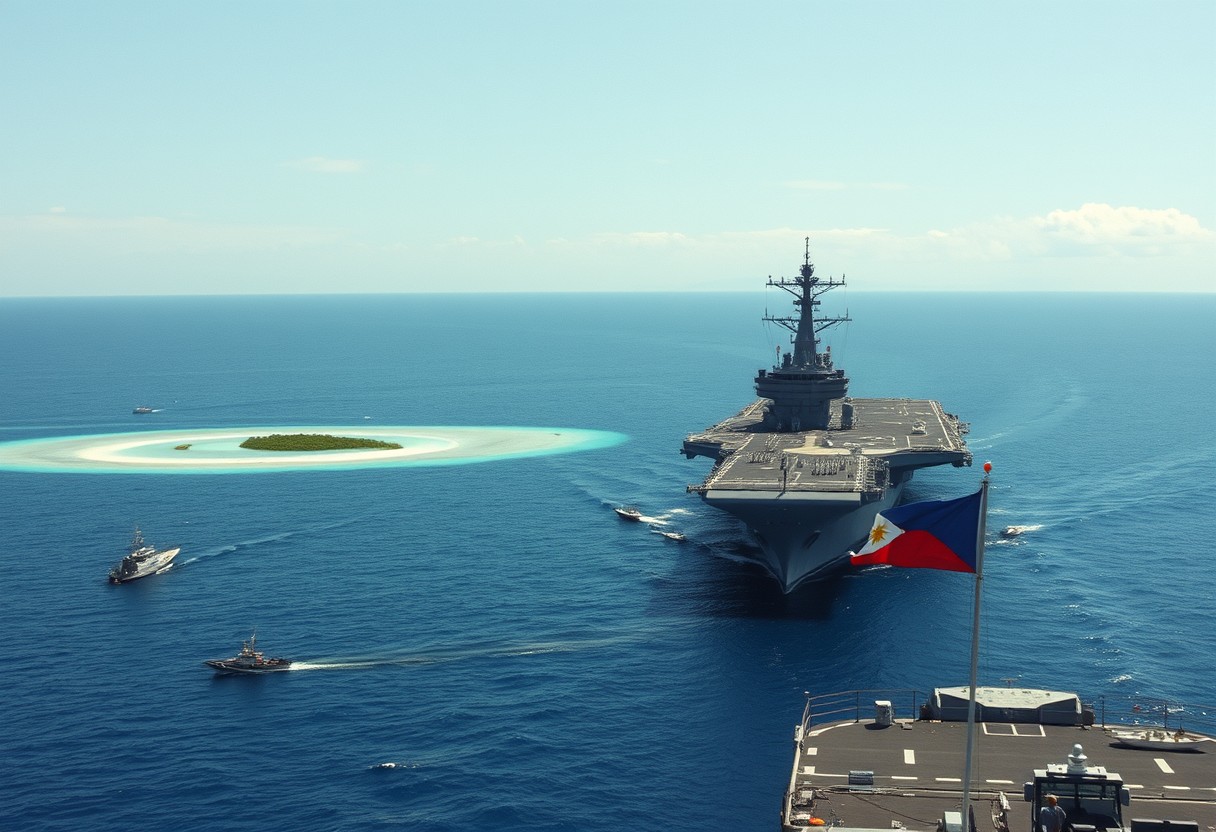
Donald Trump’s potential return to the White House has sparked intense scrutiny over how his foreign policy approach could reshape U.S. commitments in the Indo-Pacific. Known for an unpredictable and transactional style, Trump’s first-term decisions often prioritized short-term gains over long-standing strategic alliances. For the Philippines, this raises pressing questions about the reliability of American support amid escalating tensions in the West Philippine Sea, where Chinese maritime expansion continues to challenge sovereignty and international law.
The U.S.-Philippines Mutual Defense Treaty has traditionally served as a cornerstone of regional security, but past signals from the Trump administration suggested a willingness to question such alliances if deemed unfavorable. With renewed attention on freedom of navigation and regional deterrence, a second Trump term could recalibrate military cooperation, diplomatic engagement, and economic incentives in ways that directly affect Manila’s strategic posture and its ability to resist coercive actions in contested waters.
The Tragedy of Transactional Realpolitik
National interest supersedes the liberal international order as the primary driver of American engagement. The alliance is no longer viewed through the lens of shared democratic values but as a strategic asset that must provide quantifiable utility to America
American foreign policy under a second Trump administration would recalibrate alliances in the Indo-Pacific around measurable strategic returns rather than ideological alignment. Democratic governance in Manila, once a point of diplomatic emphasis, would carry little weight if it does not translate into concrete military access or intelligence cooperation. The U.S.-Philippines alliance would be assessed not by mutual commitments to rule of law or human rights, but by its capacity to counter Chinese expansion at minimal cost to Washington. This shift reflects a broader abandonment of the postwar normative framework, where coalitions were built on institutional trust and shared principles.
Security partnerships would instead resemble contractual arrangements, subject to periodic renegotiation based on shifting threat assessments and domestic political calculations in the United States. Countries like the Philippines would find their strategic value tied strictly to basing rights, surveillance capabilities, or proximity to contested waters. When democratic backsliding occurs, as seen during previous administrations in Manila, Washington’s muted response would signal that moral consistency has been subordinated to operational efficiency. The expectation forms: loyalty in conflict matters more than transparency in governance.
Manila must navigate a relationship defined by specific quid-pro-quo demands. The retreat from collective security frameworks forces the Philippines to justify the hosting of American troops in strictly transactional terms that favor American domestic priorities
Each request for U.S. military presence in Philippine territory would require explicit justification in terms of regional deterrence or direct benefit to American defense interests. Philippine officials would need to demonstrate how rotational deployments or joint exercises enhance U.S. power projection, not just local sovereignty. This dynamic pressures Manila to align its defense posture with Washington’s immediate objectives, often at the expense of long-term autonomy or regional neutrality.
American policymakers would view basing agreements not as mutual commitments under a shared security vision, but as privileges granted conditionally, revocable if domestic politics in the U.S. turn isolationist or if strategic priorities shift toward Taiwan or Guam. Philippine leaders would face mounting pressure to offer expanded port access, logistical support, or spectrum allocation for surveillance-concessions framed not as alliance solidarity but as payment for protection. The burden of proof shifts: Manila must earn continued U.S. involvement through tangible deliverables, not historical ties or democratic fellowship.
The Geography of Hard Power in the Littorals
American naval strategy shifts toward aggressive freedom of navigation operations to challenge Chinese expansionism directly. The focus moves from diplomatic protests at the United Nations to the physical reinforcement of Philippine maritime outposts in t
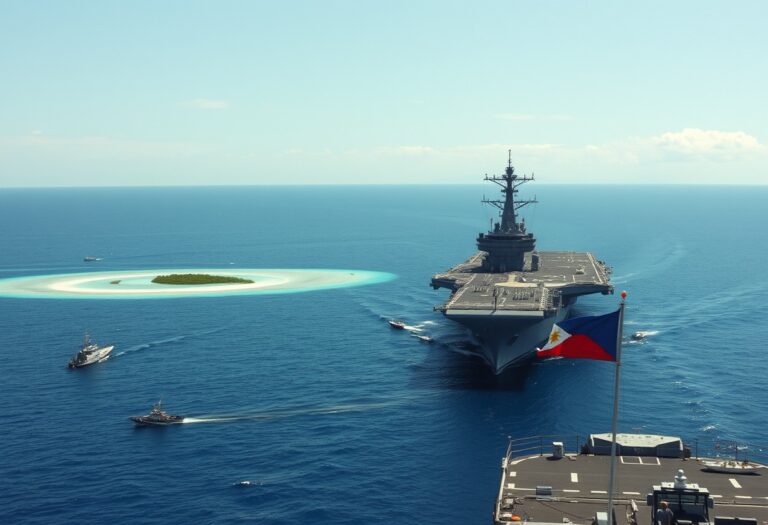
U.S. warships now conduct routine patrols within 12 nautical miles of artificial islands built by China in the West Philippine Sea, signaling a departure from symbolic diplomacy. These operations are no longer isolated demonstrations but part of a calculated pattern designed to erode de facto control through persistent presence. Aircraft carriers, destroyers, and littoral combat ships operate in tandem with Philippine coast guard units, blurring the line between training and confrontation. The shift reflects a broader recalibration in Washington: legal arguments matter less than the ability to project force where Beijing asserts dominance. When U.S. vessels shadow Chinese maritime militia near Second Thomas Shoal, they do so not to win a debate but to deny uncontested space.
A single frigate resupply mission by the Philippine navy, backed by American surveillance assets, can trigger a chain reaction of military deployments across the South China Sea. Such moments reveal how operational tempo has replaced legal briefs as the currency of influence. The Pentagon measures success not in UN resolutions but in the frequency of joint sailings and the durability of forward-deployed logistics hubs. Even port access agreements in Mindanao or Palawan carry strategic weight, enabling rapid response without reliance on distant bases. Naval power here is not about winning wars outright but sustaining pressure through constant motion-keeping sea lanes open by refusing to let them be quietly closed.
Tactical maneuvers in the littorals become the primary language of deterrence. Washington’s willingness to push back against gray-zone tactics depends on whether such actions align with a broader strategy of kinetic containment rather than a commitment to
Close-quarters encounters between Philippine and Chinese vessels near Scarborough Shoal are no longer seen as accidents but as scripted exchanges in an ongoing contest of wills. U.S. Navy advisors now embed with Philippine task forces, refining boarding procedures and radar tracking protocols during live drills. These exercises simulate scenarios where warning shots are fired, communications jammed, and supply lines tested under duress. The goal is not escalation for its own sake but the establishment of predictable thresholds that discourage unilateral action. Deterrence emerges not from declarations but from the visible readiness to respond within hours, not days.
American destroyers cutting through typhoon-lashed waters to rendezvous with Filipino supply boats signal resolve more effectively than any communique. These maneuvers convey a simple message: coercion will be met with counter-maneuvers, not footnotes. Gray-zone incursions-coast guard standoffs, fishing fleet swarms, laser targeting-lose their advantage when met with immediate tactical parity. The balance of power tilts not toward whoever claims sovereignty but toward whoever maintains operational consistency. In this environment, presence equals policy, and every patrol writes a new line in the unwritten rules of maritime conduct.
Economic Statecraft as a Zero-Sum Game
Trade policy becomes a tool for security, forcing the Philippines to choose between lucrative Chinese markets and vital American security guarantees. Manila faces the challenge of decoupling critical supply chains from Beijing while managing inflationary
Trade under a second Trump administration would likely shift further from economic cooperation to strategic coercion, with tariffs functioning less as fiscal instruments and more as geopolitical weapons. Past patterns suggest renewed and broader levies on Chinese goods, aimed at weakening Beijing’s economic leverage in Southeast Asia. Such measures could disrupt Philippine import dependencies, particularly in electronics, construction materials, and agriculture, where Chinese goods dominate at low cost. Sudden supply chain interruptions risk fueling domestic price increases, complicating monetary policy at a time of fragile recovery. Manila may find itself pressured to realign trade flows away from China, even when such shifts increase costs or reduce efficiency. Aligning too closely with U.S. trade restrictions could mean losing access to Chinese investment and market opportunities, yet resisting may strain defense coordination with Washington. The dilemma exposes the fragility of small-state autonomy in a bipolar economic order.
Philippine industries reliant on intermediate Chinese goods face operational risks as Washington treats commerce as an extension of security policy. Export-oriented manufacturers, for instance, may suffer if Chinese retaliation targets regional partners of U.S. allies. The government might respond with import diversification and local sourcing initiatives, but these require time and capital. Short-term inflationary spikes could erode household purchasing power, especially in urban centers where Chinese consumer products are deeply embedded. Manila’s ability to buffer these effects depends on its diplomatic agility and access to alternative supply networks. Choosing between economic pragmatism and strategic alignment is no longer hypothetical-it is a daily calculation shaped by decisions made in Washington and Beijing.
Competition for infrastructure investment becomes a zero-sum game. The Philippines must navigate this rivalry by securing American capital that matches the scale of the Belt and Road Initiative to maintain its sovereign interests and maritime integrity.
China’s infrastructure financing through the Belt and Road Initiative has already left a visible imprint on Philippine development plans, from roads in Mindanao to power plants in Luzon. These projects often come with opaque terms and long-term debt exposure, raising concerns about strategic leverage. A second Trump term would likely intensify efforts to counter such influence by positioning U.S. development finance as a transparent, rules-based alternative. However, American investment mechanisms like the International Development Finance Corporation operate at a fraction of Beijing’s scale, limiting their immediate impact. Manila cannot afford to reject viable funding, yet accepting large-scale Chinese loans risks compromising its maritime sovereignty, especially when projects are located near contested areas.
Philippine planners are now assessing how to attract U.S. and allied capital for strategic infrastructure without sacrificing speed or scope. Projects like the Mindanao Railway or the Subic-Clark logistics corridor could serve as test cases for American-backed alternatives. Success depends on Washington treating infrastructure not as charity but as strategic equity. Without commitments that match the speed and volume of Chinese financing, Manila may have little choice but to continue accepting Beijing’s offers, even under unfavorable terms. The infrastructure race is not just about development-it is about whose rules and influence will shape the country’s economic spine.
The Personalization of Hegemonic Alliances
The durability of the security relationship hinges on the personal rapport between the American and Philippine presidents. This personalization of diplomacy bypasses traditional bureaucratic safeguards, making the alliance more dynamic but also more susce
Trust between leaders often replaces institutional protocols when high-stakes decisions shape bilateral defense postures. A phone call from the Oval Office can shift military coordination faster than months of interagency deliberation. When President Trump previously signaled openness to direct talks with counterparts in Manila, it underscored a preference for unfiltered dialogue over layered diplomatic consensus. Such exchanges allow rapid policy adjustments but expose strategic commitments to the volatility of individual chemistry. Precedents set during his first term revealed that warm public statements between leaders could precede sudden reversals in posture-illustrating how goodwill gestures might substitute formal assurances. Bureaucratic inertia in Washington and Manila often gives way when top-level signals diverge from established foreign service guidance.
Personality-driven engagement carries inherent instability, particularly when succession alters leadership styles. Institutional memory within both countries’ defense establishments cannot fully compensate for abrupt shifts in tone or priority initiated at the summit level. Past interactions showed that mutual admiration expressed in press conferences occasionally masked deeper misalignments on operational conduct. Without codified expectations beyond the executive suite, continuity in joint exercises or contingency planning risks erosion. The absence of binding mechanisms means that personal rapport functions not as a supplement to alliance cohesion but as its central pillar-placing long-term deterrence calculations in the hands of transient sentiment.
The Enhanced Defense Cooperation Agreement is treated as a bargaining chip in a broader geopolitical negotiation. The expansion of American access to Philippine bases is contingent on the perceived benefits of the relationship to the American executive br
EDCA site expansions have increasingly reflected political optics rather than strictly military assessments. During Trump’s first term, U.S. officials tied infrastructure investments at agreed locations to broader trade and burden-sharing discussions, signaling that defense access was negotiable. Public statements from senior American officials framed base usage not as a right under treaty but as a privilege extended conditionally. This reframing allowed leverage on issues far beyond maritime security, including visa policies and bilateral tariffs. Philippine military officials noted delays in construction timelines coinciding with cooling rhetoric from Washington, suggesting alignment depended on presidential sentiment. When American demands grew, so did internal debate in Manila over sovereignty implications.
Strategic patience in Manila often met transactional impatience in Washington, where tangible returns justified forward presence. The prospect of additional EDCA sites became entangled with White House narratives about reciprocity and fairness in alliances. Decisions once managed by defense attachés and regional commands now appear subject to real-time evaluation by political appointees sensitive to media optics. Historical precedent shows that when U.S. presidents emphasize deal-making over doctrine, even long-standing agreements risk reevaluation. In this environment, Philippine officials must weigh enhanced deterrence against the unpredictability of hosting forces whose mandate may shift with a single executive comment.
Strategic Hedging in an Anarchic Region
Manila diversifies its security portfolio to avoid total reliance on an unpredictable Washington. By deepening ties with Tokyo and Canberra, the Philippines builds a network of middle-power cooperation that acts as a stabilizer in the South China Sea.
Japan has emerged as a key defense partner, supplying maritime patrol vessels and radar systems that enhance Manila’s surveillance capabilities across contested waters. These transfers are not standalone gestures but part of a broader framework of reciprocal access and joint exercises that mirror evolving regional threats. Australian support complements this effort, with defense dialogues and training programs reinforcing institutional capacity within the Armed Forces of the Philippines. Both nations share strategic interests in preserving freedom of navigation and upholding international law, particularly under UNCLOS. Their engagement offers Manila diplomatic ballast when bilateral U.S. commitments appear subject to political volatility. Unlike great power alliances marked by conditionality, cooperation with middle powers often emphasizes consistency and long-term institution-building, allowing Philippine planners to operate with greater predictability.
Trilateral drills involving Philippine, Japanese, and Australian forces have grown in frequency and complexity, signaling a shared commitment to regional stability beyond symbolic presence. These exercises focus on anti-submarine warfare, search-and-rescue operations, and coordinated responses to maritime incursions-scenarios directly relevant to tensions in the West Philippine Sea. Tokyo’s increasing willingness to project power beyond its immediate periphery reflects a recalibrated posture in response to Chinese assertiveness. Canberra, for its part, views Southeast Asian security as inseparable from its own strategic environment. The convergence of these interests enables Manila to weave a denser web of partnerships that dilute overdependence on any single ally, especially one whose foreign policy may shift abruptly with electoral cycles.
The pursuit of strategic autonomy becomes a necessity rather than a choice. This diversification creates a balance of power that ensures the archipelago’s survival regardless of the shifting political winds in the United States.
Geographic reality dictates that the Philippines cannot outsource its sovereignty to external guarantors indefinitely. With Chinese coast guard vessels maintaining a persistent presence near Second Thomas Shoal and Scarborough Reef, Manila recognizes that survival hinges on credible deterrence backed by multiple partners. Relying solely on Washington risks paralysis when U.S. priorities pivot elsewhere or when domestic politics delay decision-making. By cultivating parallel relationships with democracies like Japan and Australia, Philippine leaders create overlapping deterrent effects that complicate adversarial calculations. These ties do not replicate the full spectrum of American military reach but provide enough operational redundancy to sustain resistance during crises.
Strategic autonomy does not imply isolation or neutrality-it means expanding options in a region where coercion often precedes negotiation. Agreements such as the Mutual Logistics Support Arrangement with Japan and the Philippines-Australia Status of Visiting Forces Agreement enable faster deployment and sustained operations during emergencies. Such frameworks allow Manila to respond swiftly without waiting for unilateral U.S. approval. When combined, these arrangements form a de facto multilateral shield that tempers aggression through collective visibility. In an anarchic regional order where no higher authority enforces rules, the ability to act collectively with trusted partners becomes the closest approximation to security.
To wrap up
A second term under Donald Trump would likely reinforce a foreign policy centered on unilateral action, bilateral bargaining, and reduced institutional engagement. For the Philippines, this shift could mean greater unpredictability in U.S. responses to Chinese assertiveness in the West Philippine Sea. The absence of consistent strategic messaging from Washington may embolden Beijing to expand its maritime activities, knowing that alliance commitments could be subject to political negotiation rather than treaty obligation. Manila might find itself pressured to recalibrate its defense posture, relying more on ad hoc coordination with Washington while deepening regional partnerships to balance growing risks.
Trump’s emphasis on personal diplomacy and transactional alliances could also reshape how security assurances are perceived in Southeast Asia. Past patterns suggest that high-level endorsements may carry more weight than formal agreements, leading to short-term gains but long-term uncertainty. Philippine policymakers would need to prepare for fluctuating levels of U.S. military presence and intelligence sharing, particularly during moments of escalation. While American support is unlikely to vanish entirely, its timing and scope may depend heavily on domestic political considerations in the United States, leaving Manila to strengthen its own deterrence measures amid rising regional tensions.
About the Author