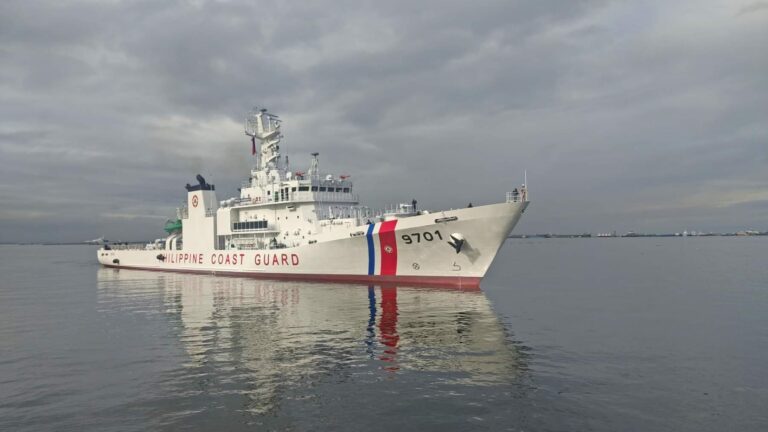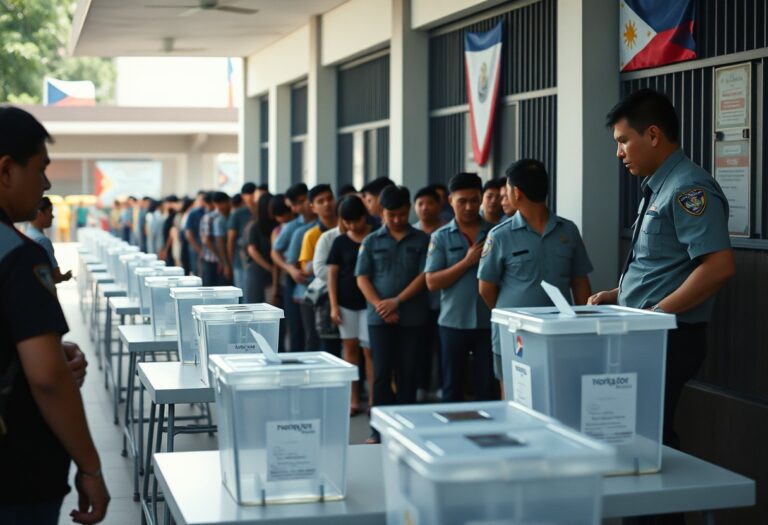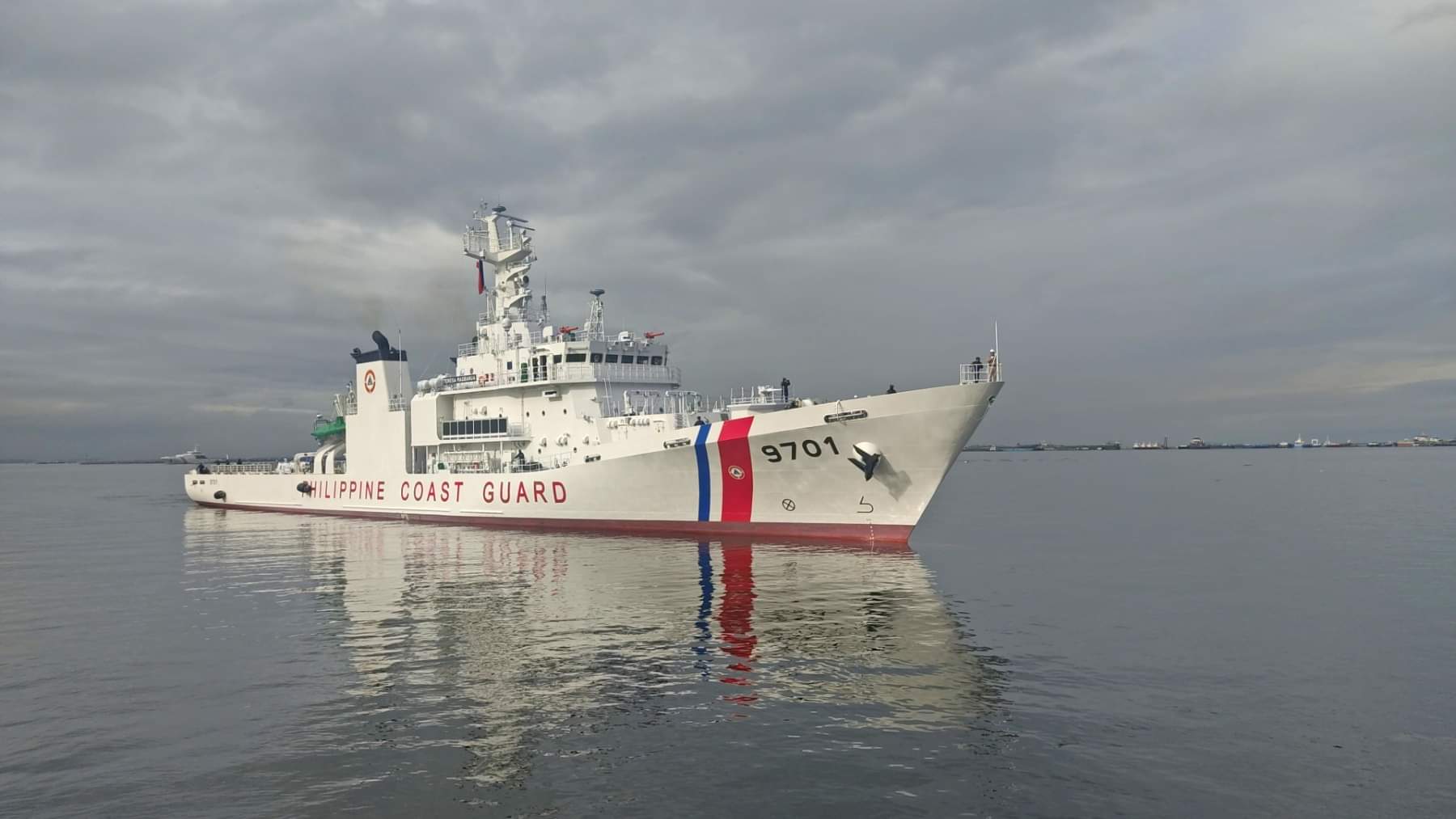
BRP Teresa Magbanua (MRRV-9701). Photo: Philippine Coast Guard (public domain), via Wikimedia Commons.
A Routine Patrol That Turned Tense
The PCG calls it a routine law enforcement operation against an illegal and destructive practice. By the time it ended, it had become one of the most tense moments in the West Philippine Sea in recent days.
The Philippine Coast Guard (PCG) said that around 7:20 a.m. on Sunday, Oct. 4, Joint Task Unit Pag-asa spotted a foreign fishing vessel apparently blast fishing. Coast Guard District Kalayaan Island Group formed an interagency team: PCG High-Speed Response Boat HSRB-019, a Philippine Navy RHIB and rubber boat, and a PNP Maritime Group RHIB.
According to the PCG, as the team left the sheltered port of Pag-asa Island around 9:50 a.m., China Coast Guard (CCG) vessels 5102 and 21581 moved toward them, blasting their horns. Around 10 a.m., the team reached the foreign fishing vessel, about 500 meters from Sandy Cay 2. Several small boats returned to the mother ship, and the vessel moved away, ignoring orders to stop.
Within 10 Yards
The PCG said CCG 21581 blocked and shadowed the Philippine team and came within about 10 yards of the PCG boat. The Filipino team stopped following and returned to Pag-asa Island around 10:48 a.m. “for safety reasons.”
The PCG said dynamite fishing is prohibited under the Philippine Fisheries Code, and “this was a routine law enforcement operation against an illegal and destructive practice. It was not directed at any country.”
The PCG added that the CCG “has no law enforcement authority in the territorial sea of Pag-asa Island.” The incident will be documented and referred through the Department of Foreign Affairs (DFA), the PCG said.
A J-16 Near a Philippine Plane
The Armed Forces of the Philippines (AFP) said that on Oct. 3, a Philippine Air Force C-208 utility turboprop on a routine maritime patrol over Bajo de Masinloc, also known as Scarborough Shoal, encountered two Chinese military planes, including a J-16 fighter.
“The J-16 repeatedly approached and maneuvered in close proximity to the Philippine aircraft, including maneuvering ahead of and around it and positioning itself within the Philippine aircraft’s wake,” the AFP said. “These maneuvers posed an aviation safety risk.”
No personnel were hurt, the AFP said, and the aircraft safely completed its patrol and returned. The AFP called the encounter part of a “recurring pattern of unsafe and coercive behavior” against Philippine government vessels and aircraft conducting lawful operations.
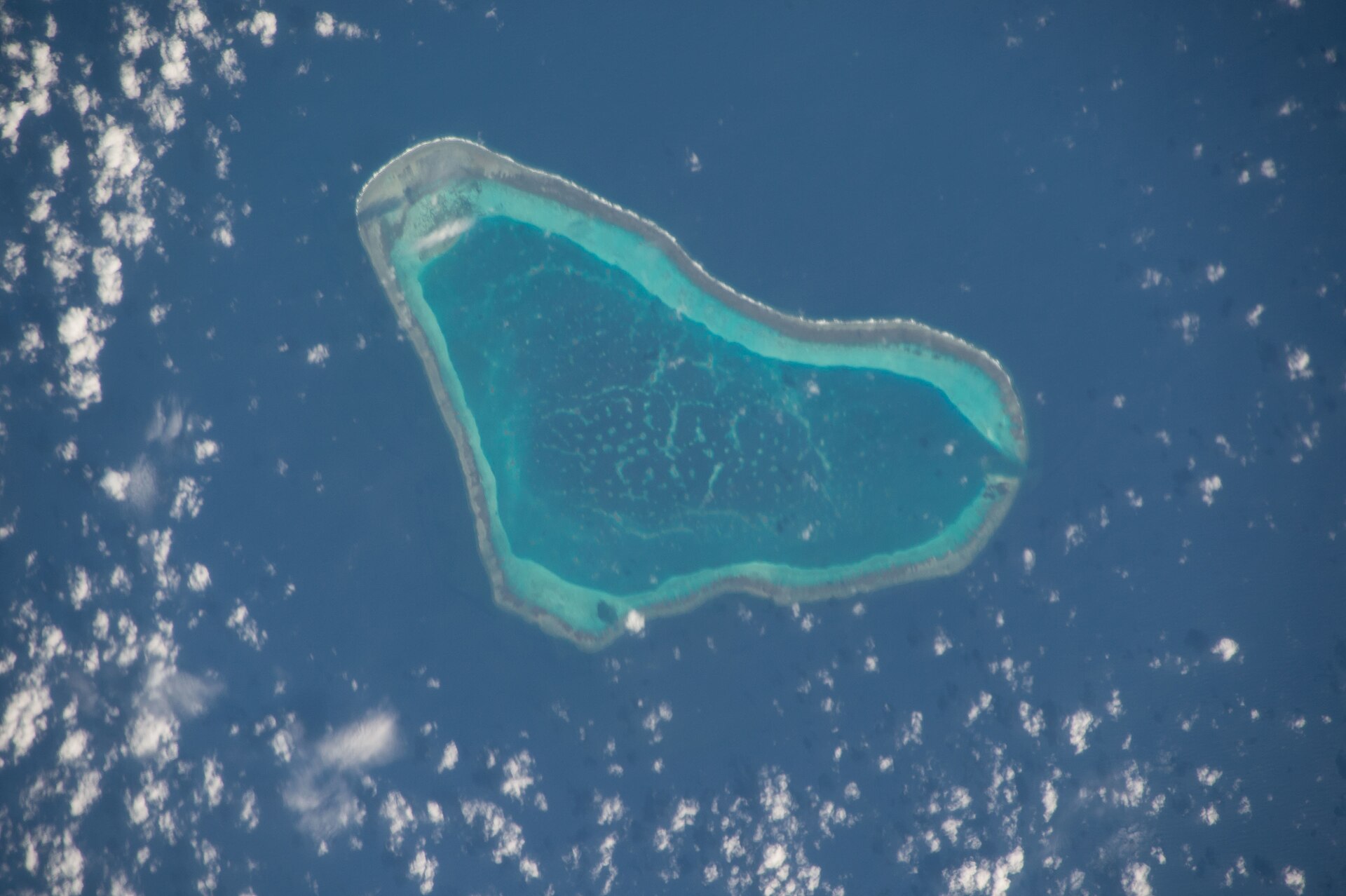
The Inquirer noted that Bajo de Masinloc lies 230 kilometers (124 nautical miles) west of Luzon and 830 kilometers from mainland China. Under the 2016 arbitral award, it is classified as a rock generating only a 12-nautical-mile territorial sea, with surrounding waters inside the Philippines’ exclusive economic zone (EEZ). The shoal has been under China’s control since 2012.
A Research Ship Off Batanes
Farther north, the PCG drove away Chinese research vessel Jia Hai Ke 7. The DFA said on Friday, Oct. 2, that the ship was detected about 69 kilometers northwest of Itbayat, Batanes, within the Philippines’ EEZ.
The PCG said the vessel left around 11:42 a.m. on Thursday, Oct. 1, after staying since its presence was confirmed on Sept. 28. The PCG deployed the 97-meter BRP Teresa Magbanua and an aircraft after the vessel repeatedly ignored radio challenges. Later, CCG vessel 2503 arrived and issued radio challenges to the Teresa Magbanua.
PCG spokesman Rear Adm. Jay Tarriela said the ship used automatic identification system spoofing and departed Xiamen on Sept. 21, according to Philstar. He said Canada’s Dark Vessel Detection verified its location. A seabed-survey vessel hiding its position while holding station in that corridor, Tarriela said, “raises serious concern over the security of the country’s undersea communications infrastructure.”
Manila Says No Consent Was Given
The DFA rejected the Chinese Embassy’s assertion of sovereign rights and jurisdiction in those waters. Citing Article 246 of UNCLOS, the DFA said marine scientific research in a coastal state’s EEZ requires its consent. “The Philippines did not receive any request from the Chinese side and no consent has been given to any Chinese vessel to conduct MSR,” the DFA said.
The Chinese Embassy had said the vessel was conducting normal operations in waters where Beijing claims sovereign rights and jurisdiction, and accused the Philippines of harassing it.
The Numbers Behind the Tension
AFP spokesperson for the West Philippine Sea Rear Adm. Roy Vincent Trinidad said 42 Chinese vessels, from the PLA Navy and the China Coast Guard, were monitored from Sept. 22 to 28, according to GMA News. That is higher than the 35 vessels counted from Sept. 15 to 21.
The breakdown: nine CCG vessels at Ayungin Shoal; eight PLA Navy and 14 CCG vessels at Bajo de Masinloc; one PLA Navy and six CCG vessels at Escoda Shoal; and one PLA Navy and three CCG vessels at the Pag-asa Islands.
Separately, Philstar reported that Trinidad said the source of tension is not the law-abiding defensive posture of the Philippines, but the continued illegal presence and coercive and aggressive conduct of China.
About the Author